1. Introduction
Water Problems in Rural Nigeria[1,2]
Nigeria’s small towns and villages still face big problems with clean water, electricity, and jobs. Many families walk long distances for water that is not even clean. Reports show that about 39% of rural homes (“Nigeria: Ensuring Water, Sanitation and Hygiene for All”) lack basic water supply, and roughly 70% of Nigerian children do not have good water right at home. This affects daily life, farming, health, and children’s education.
Regenerative Data Centers – Definition and Opportunity
Regenerative data centers are facilities that make their own power (mostly from solar), reuse water (recirculating the same water, internally, in a sealed loop, rather than purifying sewage water continuously). Companies (cloud providers) build them in rural areas mainly to save money on land and electricity. But they can also share extra power, water, and internet with nearby communities. This essay explores the real benefits, challenges, and how to make them work for ordinary rural Nigerians.
2. Power Solutions
Power Problems in Rural Nigeria
Rural areas often suffer from unreliable electricity, frequent blackouts, and high dependence on expensive diesel generators. This limits farming (irrigation pumps), health services (refrigeration, lighting), and education (computers, night study).
How Regenerative Data Centres Help[1,2,3]
Regenerative data centres generate their own power, primarily from large on-site solar arrays combined with battery storage. They consume what they need and can export the surplus to the local community or grid. the data center's 24/7 backup battery infrastructure (BESS) can be tapped to stabilize the community's water pumps at night or during cloudy days when solar generation drops.
Table 2.1 – Power Surplus Scenarios
Scenario Electricity Consumed Per Day Electricity Generated (Solar) Net Surplus / Equal to How Many Homes or People
Traditional data center 720 MWh - draining local resources Minimal (mostly imported) Deficit / Strains local grid
Regenerative (solar + storage) 860 MWh - not draining local power resources 1100-1300 MWh Potential surplus of 240-440 MWh / Powers 2000-3,600 rural homes
3. How Much Water Does a Regenerative Data Centre Save?
Water Problems in Rural Areas[1]
In many villages, people drink from open wells, rivers, or ponds. This causes sickness. Government programs exist, but they do not reach everywhere.
Basic Water Needs[3]
A normal person needs about 50 litres of water per day for drinking, cooking, bathing, and cleaning.
Regenerative Data Centre Water Use[4,5]
A regenerative cloud service data centre, can cut water use from 65% to 85% over a year, when compared to a traditional data centre which uses water from muncipal sources. When the data centre is first opened, the data centre water tanks must be initially filled with enough water that would normally be used by roughly 16,800 people. Every day it replensihes its tanks with the water it loses, which amounts to the water needs of 20 people.
Table 3.1 – Data Centre Water Usage Scenarios
Scenario Water Required For an Initial Fill Equal to How Many People’s Basic Needs (Initial Fill) Water Used Per Day Equal to How Many People’s Basic Needs (Daily Water Use)
Old-style data center 2.1 million litres 50,000 people 2.1 million litres 50,000 people
Regenerative (60% less water) 840 thousand litres 16,800 people 1000L 20 people
4. How Does a Traditional Data Centre Waste Water?
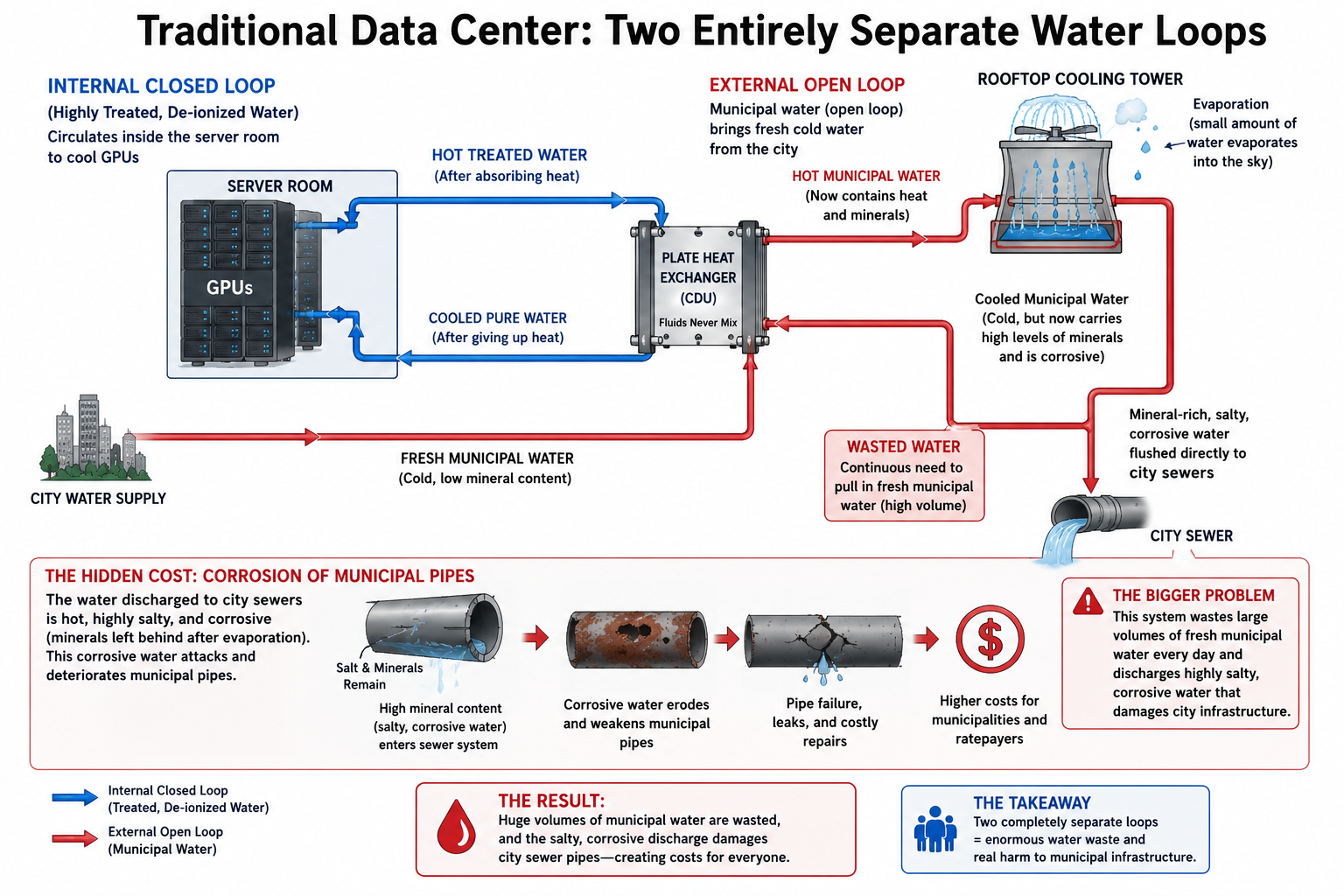
Two Separate Loops
A traditional data center has two entirely separate water loops. The internal loop is a closed-loop that contains highly treated, de-ionized water that continuously flows through pipes inside the server rooms to cool the GPUs. Once this treated water extracts heat from the GPUs, it becomes too hot to be reused and must be cooled down again.

This cooling occurs via a separate external loop. This is an open-loop that continuously brings fresh water from municipal sources into the building. It passes through a specialized device called a Plate Heat Exchanger (or Coolant Distribution Unit), where the cold municipal water absorbs the heat from the hot treated water without the two liquids ever mixing. This now-hot municipal water is pumped up to a cooling tower on the roof. In the tower, a small amount of the water evaporates into the sky to cool the rest down. This evaporation leaves all the natural minerals behind, transforming the remaining water into a highly salty, corrosive fluid that can no longer be used without destroying the pipes. It is then flushed directly into city sewers, requiring the system to constantly pull in fresh municipal water.
Can anyone see the problem here for municipalities?
Regenerative Data Centers in the Circular Economy: How They Can Help Rural Nigeria in Farming, Health, and Schools
5. How Does a Regenerative Data Centre Save Water?
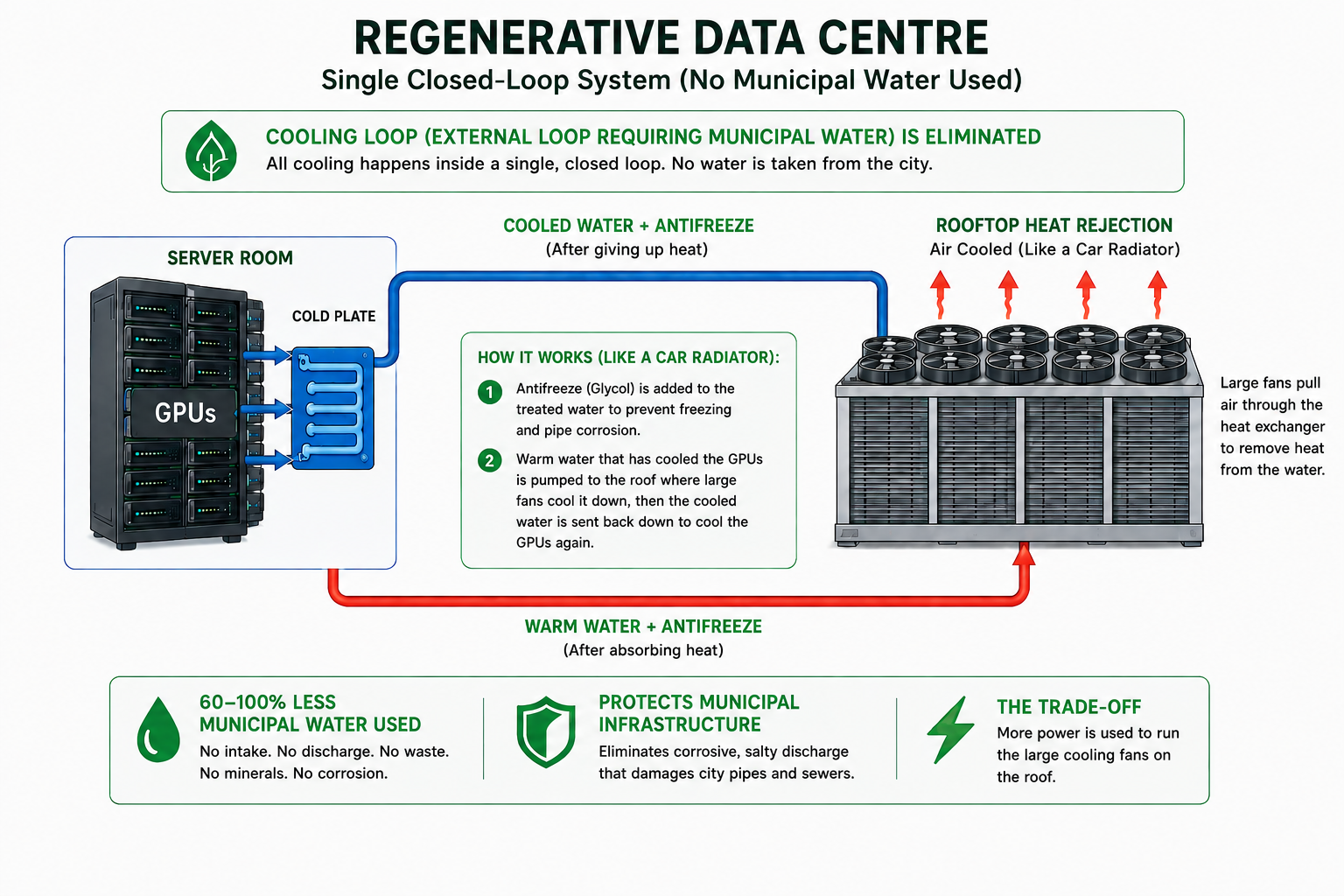
Just one closed loop
The regenerative data center, eliminates the cooling loop (the one using municipal water) in the traditional data centre. This is what enables the big water savings (60–100%) The cooling works like a car-radiator. Which means:
    1. Anti-freeze (Glycol) is added to the pure water to prevent freezing and pipe corrosion.
    2. The now warm water used to cool the GPU's is sent to the roof where it's cooled by large fans, and sent back down to the pipes to cool the GPU's again.

The trade-off? More power is used because it propels the cooling fans
Regenerative Data Centers in the Circular Economy: How They Can Help Rural Nigeria in Farming, Health, and Schools
6. How Does Data Centre Water Usage Help Rural Communities
Excess Clean Water for Communities[1]
Data center providers do fund and build water treatment facilities for communities, but they never give away water that they have used themselves. Instead, they take water that the community cannot use (like sewage or salty ground water), clean it up, use it for themselves, and fund regional infrastructure projects to offset their footprint.

    1. The "Reclaimed Water" Swap (Most Common)Data center companies do not clean water to send to residents; they do the exact opposite to protect drinking supplies.How it works: Hyperscalers like Google and Microsoft build localized water treatment plants inside their boundaries. They take in municipal sewage effluent (greywater/wastewater) from the town. They treat it on-site so it is clean enough for data center cooling towers.The Community Benefit: By using recycled sewage water, the data center leaves 100% of the town’s clean drinking water wells completely untouched.

    2. The "Water Positive" Replenishment Funding. When tech giants promise to be "Water Positive by 2030" (meaning they return more water to the planet than they consume), they are not handing out bottles of water from the server rooms. They fulfill this by investing millions of dollars into regional environmental engineering projects:Funding the repair of leaky municipal city pipes to prevent water loss. Paying to restore dried-up public wetlands, rivers, and natural aquifers.Installing filtration systems on public town wells that are currently contaminated.

While this model serves as a proven global blueprint, it has yet to be implemented in Nigeria. Currently, most data centers in hubs like Lagos utilize basic air-cooling out of necessity to avoid straining the city’s fragile water grid. However, under the Electricity Act of 2023, modern Nigerian data centers are beginning to build independent clean energy microgrids. For future AI facilities expanding into rural Nigeria, combining these independent power microgrids with a dedicated 10% water filtration bypass represents a massive, untapped opportunity to leapfrog traditional infrastructure, allowing tech providers to power their servers while simultaneously resolving local drinking water shortages for up to 5,000 rural families.
7. Waste Created vs Waste Handled
E-Waste from Server/GPU Refreshes (Every 2–5 Years)[1]
The Problem: High-density AI chips (GPUs) and servers degrade or become obsolete quickly. When they are replaced, they create bulk hazardous solid waste.
Specifics: This waste stream consists of discarded server chassis, silicon wafers, copper cabling, central processing units (CPUs), graphics cards (GPUs), lithium-ion or lead-acid backup batteries, and fiberglass circuit boards.
The Chemical Threat: These components contain highly toxic heavy metals and flame retardants, specifically lead (in soldering), mercury (in older switches and displays), cadmium (in semiconductor chip resistors), hexavalent chromium (in anti-corrosion metal coatings), and brominated flame retardants (BFRs) inside plastic casings. If unmanaged, these materials do not decompose and pose a permanent contamination risk.
What about the waste generated by the rooftop cooling process?[2]
Heat: Intense, continuous low-grade industrial heat is expelled directly into the atmosphere by the massive rooftop cooling fans.
What about the glycol in the pipes and cold plates that cool the GPUs?[2]
Maintenance Flushes: Just like a car radiator, the water-glycol fluid traveling between the GPUs and the rooftop fans degrades over time. Every few years, the entire pipe system must be flushed out. This old, highly toxic liquid must be safely collected and stored in industrial drums on-site so it never touches the soil, and the now empty water tanks must be re-filled with municipal water that is de-ionized on-site and mixed with new glycol inhibitors
What happens if internal server components break?[2]
Accidental Spills: When a server component or pipe fitting cracks, the system automatically shuts off fluid to that section. However, this still results in a small, localized spill of toxic water and glycol inside the facility, which must be carefully cleaned up using specialized hazardous waste materials.
8. Waste Summary
Table 8.1 – Waste Streams and Environmental Burden
Cooling & Lifecycle Scenario Waste Created & Primary Types Waste Handled / Recycled Internally Net Environmental Burden (Negative Impact Equivalent)
Traditional Data Center Continuous industrial heat, daily corrosive chemical wastewater, and bulk e-waste (lead/mercury) every 2–5 years. 30-50% (High amounts of raw hardware and polluted water are discarded externally) CRITICAL: Strains municipal sewage systems, corrodes city pipes, and pollutes local waterways. Equivalent to the unmanaged waste footprint of 1,000+ homes.
Regenerative Data Center Continuous industrial heat, periodic flushes of toxic glycol fluid/battery washes, and bulk e-waste (heavy metals) every 2–5 years. 80-90% (Closed-loop liquid containment, hardware recycling, and electronic refurbishment) LOW: Safe on-site storage prevents environmental leaks. If containment fails, toxic glycol fluid poses a localized hazard equivalent to the unmanaged chemical waste of 100-500 rural homes.
9. How Rainwater Washes Contaminants into the Soil
Risk of Leaching from Stored E-Waste[1,2,3]
Even if e-waste is stored in containers inside enclosed buildings, risk remains if containers leak, rust, overflow, or are moved outdoors. Rainwater can enter through poor seals, flooding, or during transport, creating leachate that carries heavy metals into the soil and groundwater.
Simple Solutions to Prevent Contaminants from Entering the Soil[4]
Table 9.1 – Solutions For Removing Contaminants
Stakeholder Simple Solutions How It Stops Soil Contamination
Government - Mandate sealed, elevated containment with concrete bases and drainage
- Regular inspections
Catches leaks/runoff before it reaches ground
Rural Residents & Communities - Use raised, covered storage sheds (local materials)
- Elevate containers on pallets
- Plant vetiver grass or sunflowers as these flowers trap the toxins in their roots, after a spill occurs
Prevents rainwater contact and absorbs minor spills
Data Center Operators Install spill trays/liners and roofed collection yards Blocks direct leaching
10. Handling Data Centre Waste: Full-time jobs
Table 10.1 – Direct Full-Time Technical Careers
Job Title & Environment Core Responsibilities Education & Skill Requirement Steady Staffing / Local Earnings
Server Dismantling Technician (100% Manual Labour) Deconstructing obsolete server chassis during 2–5 year hardware refresh cycles; physically isolating valuable components. NO DEGREE NEEDED. Requires vocational training in manual dexterity, hand tools, and mechanical disassembly. 10–20 full-time jobs; steady monthly salary.
Hardware Diagnostics Specialist (80% Computer / 20% Manual) Plugging harvested parts into testing rigs and running diagnostic software to separate working units from scrap hardware. UNIVERSITY DEGREE OR OND PREFERRED. Requires basic computer literacy, database entry, and hardware troubleshooting knowledge. 5–10 full-time jobs; high-paying technical tier.
Closed-Loop Fluid Handler (100% Manual Labour) Executing routine water-glycol system flushes and safely pumping degraded internal cooling liquids into sealed industrial storage drums. NO DEGREE NEEDED. Requires strict vocational safety training in industrial fluid handling, plumbing fittings, and chemical containment. 3–5 full-time jobs; safety and environmental priority.
Battery Maintenance Tech (50% Manual / 50% Computer) Servicing the massive solar battery bank (BESS), cleaning chemical washes, and monitoring digital battery cell health. VOCATIONAL CERTIFICATION REQUIRED. No degree needed, but requires certified training in high-voltage electrical safety and digital sensor monitoring. 3–5 full-time jobs; high-responsibility technical role.
11. Handling Data Centre Waste: Local Contractual and Side-Hustle Opportunities
Table 11.1 – Community Contractual & Watchdog Roles
Opportunity Type & Environment Core Operations Education & Skill Requirement Local Income Potential
Independent Soil & Site Tester (Manual Field Work + Digital Tool) Collecting field samples and using simple, portable digital chemical kits to audit perimeter soil and groundwater for trace leaks. NO DEGREE NEEDED. Basic literacy required. Handled entirely via simple, 2-week vocational training on how to use portable testing kits. 5–15 reliable part-time roles; ₦50,000–150,000/month to guarantee community safety.
Secure Logistical Transporter (100% Manual Labour) Driving and securing heavy transport trucks to haul sealed chemical drums and residual e-waste to certified federal processing hubs. NO DEGREE NEEDED. Requires a valid commercial driving license (CDL) and practical vocational training in securing hazardous cargo loads. Steady seasonal contract revenues; estimated at ₦100,000–350,000 per hauling cycle.
Preventative Buffer Farmer (100% Manual Labour) Planting, weeding, and maintaining deep-rooted vetiver grass and sunflower shields around containment yards to act as underground filters. NO DEGREE NEEDED. Built entirely on traditional manual farming skills and basic vocational knowledge of plant spacing for soil filtration. 5–15 seasonal agricultural roles; ₦50,000–150,000/month based on site acreage.
Root-Zone Agribusiness Operator (100% Manual Labour) Managing local cooperative greenhouses warmed passively by the data center's underground hot water loops. NO DEGREE NEEDED. Relies on manual vocational farming skills, greenhouse cultivation, and managing soil moisture. Boosts independent smallholder farming revenues by enabling accelerated, year-round vegetable yields.
12. Handling Data Centre Waste: Side Hustles - (Trash to Cash)
Table 12.1 – Upcycled Commercial Retail Products
Raw Material & Craft Environment Finished Manufactured Product Vocational Skill Required Market Target / Retail Earnings
Polyethylene (PE) Foam Planks (Manual Craft) Commercial-Grade Fishing Floats & Boat Fenders: Dense unboxing foam cut and shaped to keep nets floating or protect boat hulls. NO DEGREE. Simple manual skill using basic cutting tools and hot-wire foam shaping. Sold to river/coastal fishing cooperatives; side hustle yielding ₦40,000–120,000/month.
High-Density Isolation Mats (Manual Craft) Anti-Fatigue Floor & Livestock Mats: Thick, waterproof shipping pads cleaned, cut to size, and edge-bound for durability. NO DEGREE. Requires manual labor skills using industrial power washers and basic binding tools. Sold to daily market vendors standing on concrete and local livestock pens; high local demand.
Jacketed Cat6 Ethernet Cable (Manual Craft) High-Strength Utility Rope & Fence Ties: Multi-strand networking cables braided tightly together using simple wooden hand-cranks. NO DEGREE. Uses basic, traditional hand-weaving and rope-braiding skills using a manual wooden crank. Sold to farmers and construction sites; completely weather-proof, rust-proof rope with zero stretch.
13. Other Full-Time Jobs in a Regenerative Data Centre
Table 13.1 – Core Facility Operations & Maintenance Careers
Job Title & Environment Core Responsibilities Education & Skill Requirement Estimated Full-Time Roles
Industrial Electrician Maintaining high-voltage power, switchgears, and distributing renewable energy to servers. Vocational certification (no degree needed); high-voltage safety training. 5–12
HVAC / Cooling Mechanic Servicing rooftop cooling fans, piping, and maintaining optimal server temperatures. Vocational refrigeration, plumbing, and mechanical training. 5–10
Industrial Solar Operator Cleaning solar panels, repairing mounting brackets, and monitoring power inputs. Vocational solar panel wiring and inverter training. 10–20
Network Infrastructure Tech Physically installing, routing, and patching fiber-optic and Ethernet cabling. Basic computer literacy and cable management training. 4–8
Critical Facilities Security Managing access, perimeter patrols, and securing infrastructure. Situational awareness and security training. 15–30
Control Room / SCADA Operator (100% Computer Environment) Monitor all systems using live on-site screens (HMIs), coordinate with floor technicians to fix daily issues. NO UNIVERSITY DEGREE REQUIRED. 3-month vocational certification. 15–30 staff members (rotating across 24/7 shifts)
14. Advanced Technical Contracts in a Regenerative Data Centre
Table 14.1 – Commissioning, Upgrades & Instrumentation Contracts
Contractual Role & Environment Core Operations Dual-Track Education & Certified Skill Requirement Contract Structure & Frequency
BMS & Power Controls Team (30% Manual / 70% Computer) Programming building automation software, optimizing HVAC controls, and auditing solar grid metrics. DUAL-TRACK: Lead Engineers need B.Eng/HND in Electrical/Systems Engineering. Project-based corporate contracts paid per deployment or energy audit cycle.
Instrumentation & Controls (I&C) Team (50% Manual / 50% Computer) Calibrating thermal sensors, programming PLCs, and troubleshooting automated valve communications. DUAL-TRACK: Requires an Automation degree or hands-on mastery in sensor wiring loops. Seasonal contracts during initial facility builds or capacity upgrade windows.
Solar Inverter Engineers (70% Manual / 30% Computer) Commissioning industrial solar inverters and syncing tracking software with battery storage (BESS). DUAL-TRACK: Requires an Electrical Engineering degree. Short-term contracts active during solar array setup or battery overhauls.
Fiber Optic Splicing Team (100% Manual Vocational Skill) High-precision fusion splicing on regional backbone lines to guarantee zero packet loss. VOCATIONAL FOCUS: Design needs network degrees. Splicing requires certificates Fixed-term contracts during network layout/upgrades.
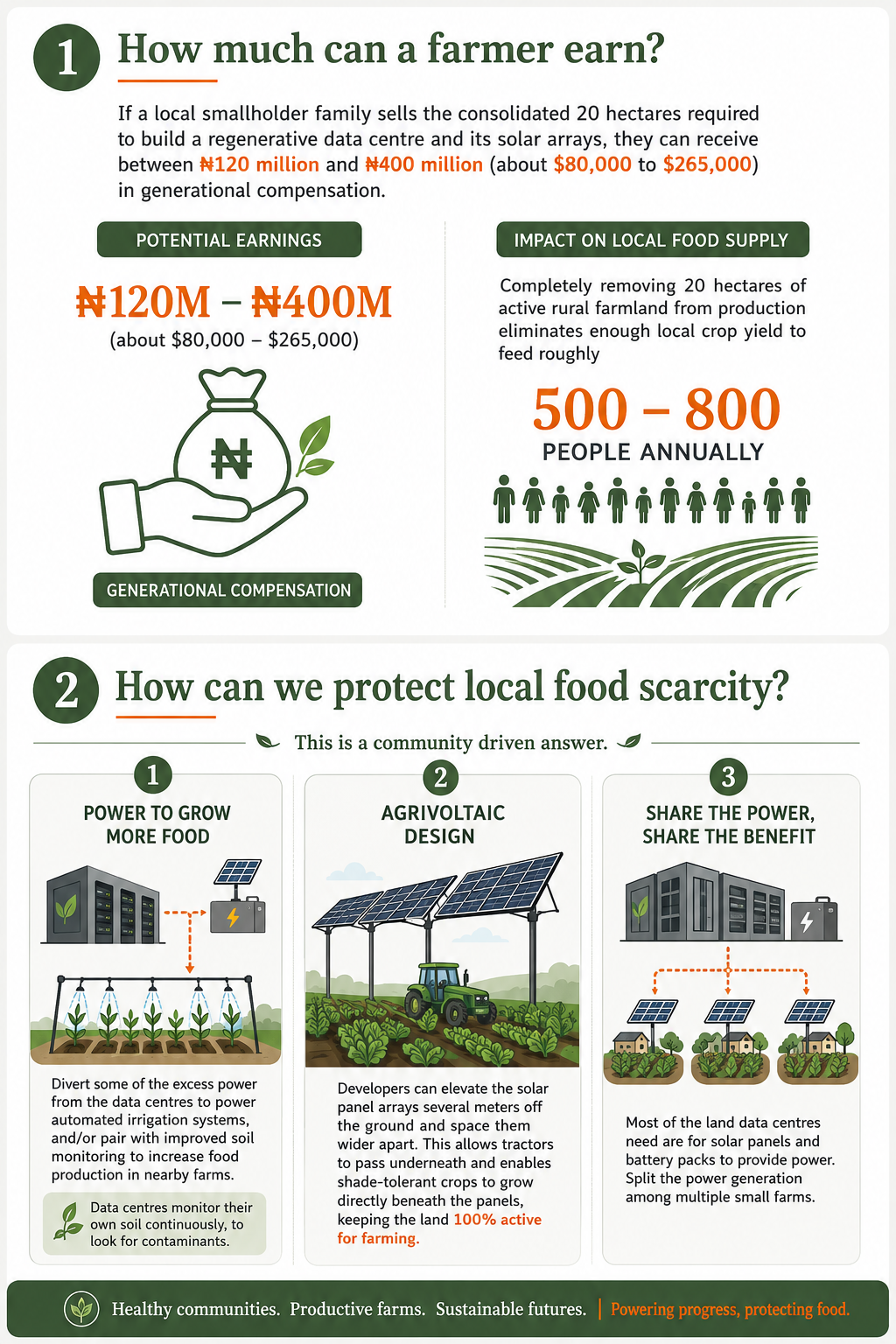
15. Who Gains and What They Get - The Farmer Who Sells The Land
16. Who Gains and What They Get - Those Close To the Data Centre
How Close to the Data Centre?[1]
If the community negotiates well, people living nearby (0.5 to 3 km away) can get:
  • Reliable electricity (saves money on generators), and good internet
  • Extra clean water for drinking and farming
A normal household in this zone could gain ₦180,000 to ₦650,000 per year in savings and extra earnings from better farming and business.
The noise from the data centre requires housing and businesses to be situated at least 300 metres away from the centre
17. Who Gains and What They Get - Education, Especially for Young Girls
Education, Especially for Young Girls[1,2]
Reliable power means schools can have computer labs and night classes. Programs like this have helped increase girls’ school attendance by 20-50% in similar projects. The centre can support scholarships and after-school STEM clubs.
Better education for young girls is the biggest benefit of a data centre
18. Who Loses
Local IT Technicians[1,2]
Local IT shops that install and maintain servers for businesses, clinics, and schools may lose work. Many people prefer local servers because they do not trust the cloud or “big brother” watching their private or cash businesses. This group (maybe 3–15 people per small town) could lose 30–70% of their income. They will need help to learn new skills like maintaining solar systems or helping some people move to the cloud safely. However the job of an IT person is to adapt quickly to changing technology, that’s their edge over other professionals.
19. Groups That Stay Mostly the Same
Small Shops and Farmers Living Farther Away[1,2,3]
Without the necessary government intervention and funds for public works, small shops and farmers living farther away (more than 5–8 km) will probably see little direct change. They neither gain much nor lose much in the beginning. Their daily farming and shop work continues as before.
The Cash Economy
Some cash-based businesses may lose customers as more people use digital payments and online sales. But rural communities have survived for thousands of years because they know how to adapt. Cities change fast, but villages last because people are creative under pressure and good at surviving. Shops can slowly add digital payments and online selling while keeping the trust that makes them strong.

For example: Communities along the Benue River are heavy producers of yams, cassava, rice, and fresh fish. They rely on traders traveling up the river or via major commercial hubs like Makurdi and Yola. Nothing will change for these communities as they can still rely on traditional hand-to-hand transactions at local river markets (like the Wadata market in Makurdi)
20. What Should The Government Do
Recommended Actions[1,2]
The local government should set clear rules to protect water sources and make sure communities get real benefits. State and local governments must establish clear zoning laws to protect the fragile River Benue floodplain from industrial development.

Companies should build the centers and share extra power and water. Local people should negotiate strongly for jobs, water, and education support. The best projects will combine solar panels with farming (agrivoltaics), extend power and water to more villages, and train local people for the new jobs.
Local Action is Key[3]
We all want governments to do more, but governments take time to enact their agendas. Locals are more nimble and adept at getting things done quickly, which is why negotiations should be done locally.
21. What Should Locals Do in the Meantime to Get Clean Water
Side Hustles and Self-Reliance Enabled by Data Centre Benefits[1]
Just like the success stories in our articles, good electricity and internet help people create and sell farm products, crafts or other useful creations, with better profit margin. Perhaps a store can start a small export business. Young people good with technology can create new side hustles while older people can create side hustles using traditional work and their superior communication skills (which in the age of AI become even more important). This is the second biggest benefit of a data centre, as these new opportunities can enable individuals, businesses, schools etc, to purchase inexpensive personal clean water solutions until governments extend the water treatment benefits of a regenerative data centre to more residents.
Recommended Personal Water Solutions[2]
Examples of these include LifeStraw bottles or LifeSaver Jerrycans for schools and homes. These cost between $30 and $300 upfront and last for years. Vendors often give discounted prices to needy areas, and government subsidies or NGO programs can help. The extra income from new side hustles and jobs makes it easier to buy these tools.
These personal water filtration and purification systems act as an important shield against Bilharzia (Schistosomiasis) while people work the riverfront
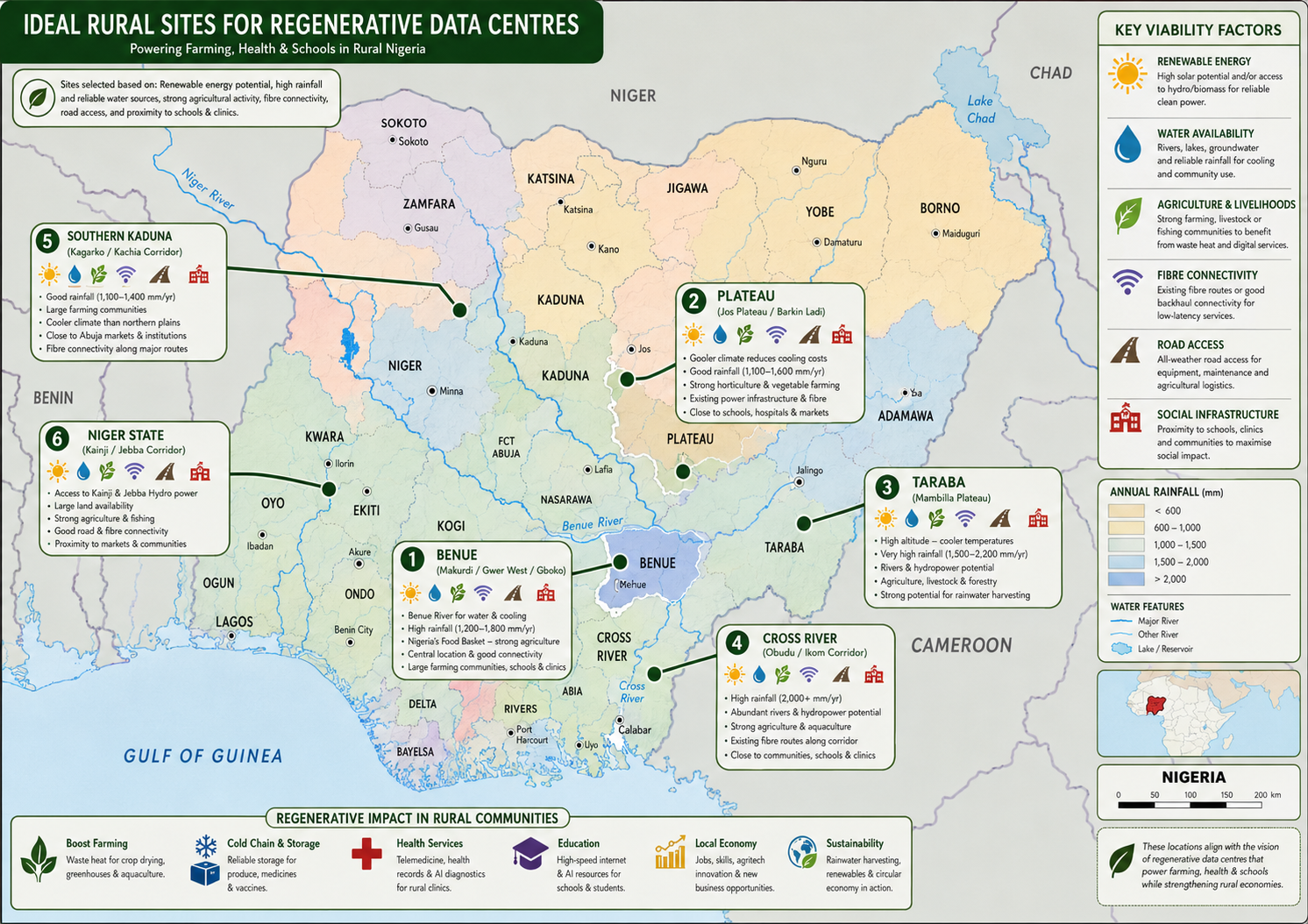
22. Ideal locations in Nigeria
Regenerative Data Centers in the Circular Economy: How They Can Help Rural Nigeria in Farming, Health, and Schools
23. Conclusion
Conclusion
Regenerative data centers are not perfect, but they can bring real help to rural Nigeria if done carefully. They offer extra power, water, and internet that government projects often take too long to deliver. The biggest winners are the land seller and people living close by. Most others see little change at first. Local IT people may lose some business but can adapt. Rural people have always adapted to change, this is just the next test of that strength. With good policies, honest negotiation, and community involvement, these centers can support better farming, cleaner water for health, and new education opportunities. They can help build a stronger future without forgetting the human strengths that have kept villages alive for centuries.
Self-Reliance and Human Skills in the Age of AI[1]
Even with a data center nearby, people should not wait for everything to be given to them. They can buy simple, affordable tools for safe drinking water such as LifeStraw bottles or LifeSaver Jerrycans for schools and homes. These cost between $30 and $300 upfront and last for years. Vendors often give discounted prices to needy areas, and government subsidies or NGO programs can help. The extra income from new side hustles and jobs makes it easier to buy these tools. Rural people’s strong communication and negotiating skills are survival skills in the age of AI. Studies show that people with good negotiation and people skills earn 15–35% more as businesses grow, even when AI handles technical tasks (World Economic Forum Future of Jobs Report and Harvard Business Review studies on soft skills premium). As the local economy improves, these human skills become more valuable for making deals, building trust, and creating new opportunities.
Anthony Dimitrokalis
Founder, Syndesi and Its subsidiaries
theworldcanbeyours.com
0
Would love your thoughts, please comment.x
()
x