−Is it:
Select only one of the following:
- a. The Middle East
- b. China
- c. Latin America
- d. Europe
- e. India
Look closely at the image below for clues:

+And the answer is ...
LATIN AMERICA
Do you know why Latin America takes the crown?
It’s home to this planet’s biggest superfood.
It’s everywhere, even more pervasive than social media.
It’s probably in the food you’re eating right now.
Maybe in what you’re drinking.
It might be powering your car, heating or cooling your home as you read this, feeding your pet, or the farm animal that ends up on your plate.
That crop is corn.
The Middle East gave us bread and domesticated animals.
China gave us rice and noodles.
But corn, born in Mexico and Central America, quietly took over the modern world. It became the backbone of industrial food systems in a way no other crop has matched.
That’s why, when we ask which region is most responsible for the food we eat today, the answer points straight to Latin America, and specifically to Oaxaca, one of the original homes of corn.
And for those in the neighboring countries that can also claim early cultivation of corn, don’t worry, your turn is coming soon.
We’re skipping the beaches this time. This trip is about food.
It’s home to this planet’s biggest superfood.
It’s everywhere, even more pervasive than social media.
It’s probably in the food you’re eating right now.
Maybe in what you’re drinking.
It might be powering your car, heating or cooling your home as you read this, feeding your pet, or the farm animal that ends up on your plate.
That crop is corn.
The Middle East gave us bread and domesticated animals.
China gave us rice and noodles.
But corn, born in Mexico and Central America, quietly took over the modern world. It became the backbone of industrial food systems in a way no other crop has matched.
That’s why, when we ask which region is most responsible for the food we eat today, the answer points straight to Latin America, and specifically to Oaxaca, one of the original homes of corn.
And for those in the neighboring countries that can also claim early cultivation of corn, don’t worry, your turn is coming soon.
We’re skipping the beaches this time. This trip is about food.

+What does Trip Advisor tell me to do
Oaxaca de Juárez & the road to Puerto Escondido
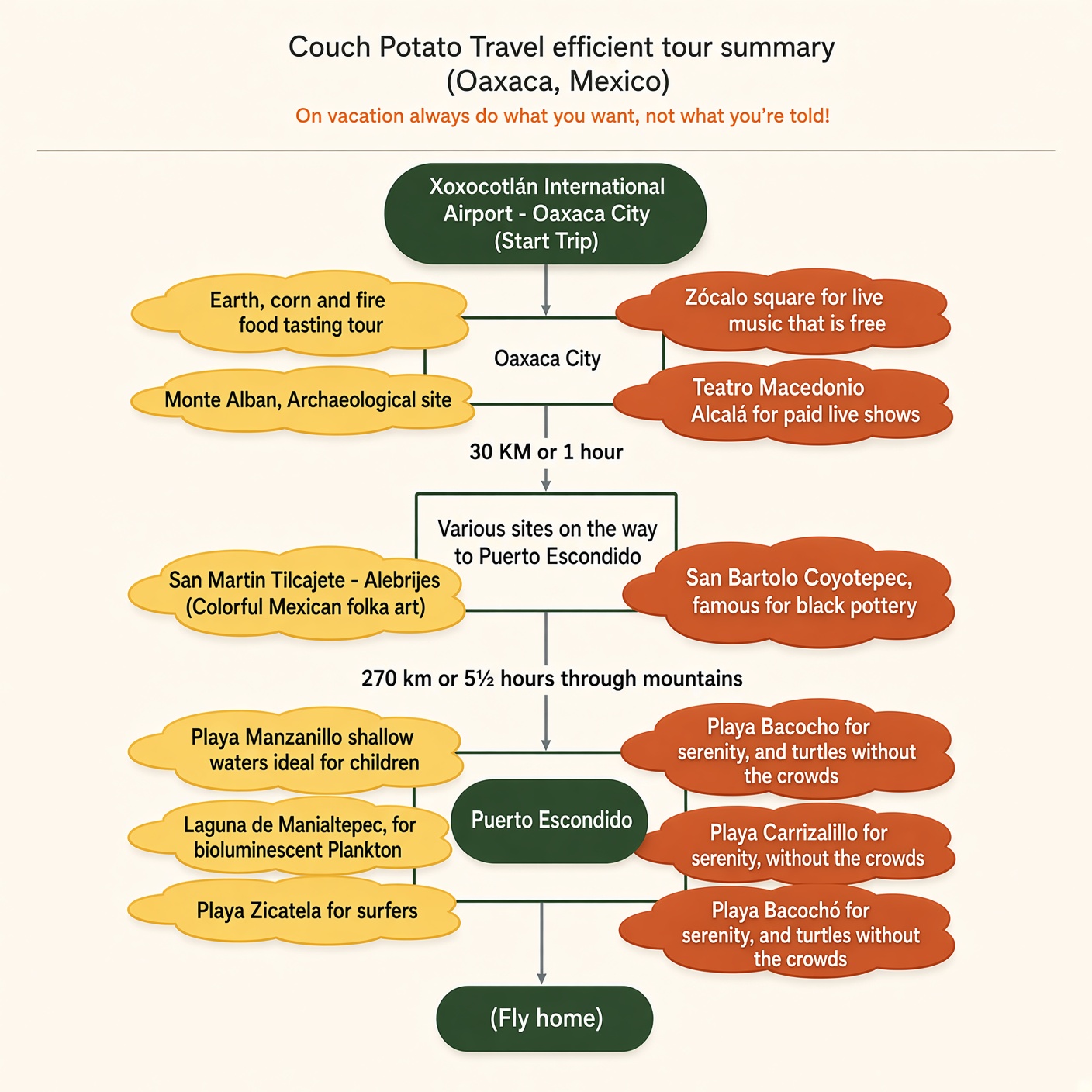
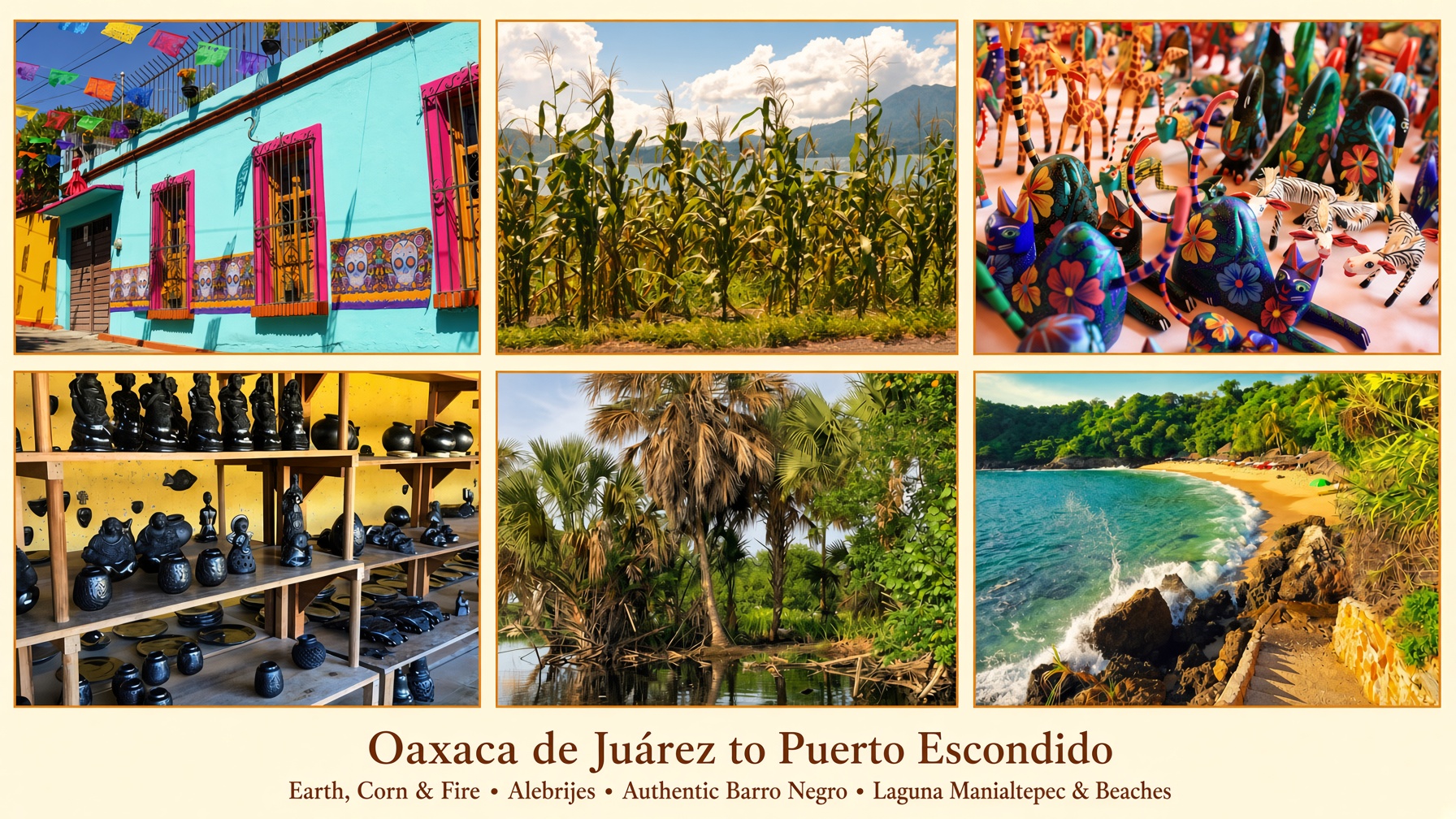
In Oaxaca de Juárez, the best way to experience the world’s most important crop is the tour called “Earth, Corn and Fire, Tasting the Roots of Oaxacan Cuisine.” This region is widely regarded as the culinary peak of Mexico, and the city of Oaxaca sits right at its center.
On the way to Puerto Escondido (roughly 250 km through the Sierra Madre del Sur, about 6 hours by road), two excellent stops stand out:
Once you reach Puerto Escondido, take time for the beaches, then head to Laguna de Manialtepec for the night tour to see the bioluminescent plankton that lights up the water.
On the way to Puerto Escondido (roughly 250 km through the Sierra Madre del Sur, about 6 hours by road), two excellent stops stand out:
- - San Martín Tilcajete , famous for its brightly painted Alebrijes, the fantastical wooden creatures of Mexican folk art.
- - San Bartolo Coyotepec, home of the renowned black pottery, with its deep mirror like finish.
Once you reach Puerto Escondido, take time for the beaches, then head to Laguna de Manialtepec for the night tour to see the bioluminescent plankton that lights up the water.
+References and tour summary
The references
Springler Link(Regional benefits of climate change), Advancing Earth and Space Sciences(Regional benefits of climate change), Mdpi(Regional benefits of climate change), National Science Review(Regional benefits of climate change), Ecology Society of America(Corn for energy production), Journal of Environmental Quality(Corn for energy production), Cambridge University Press(Corn for energy production), American Chemical Society, (Cows for energy production), Frontiers(History of corn in Oaxaca, Mexico), Biotechnia (History of the Avocado in Oaxaca, Mexico)
All images are AI-generated using Fotor and are meant to describe the subject matter they portray figuratively, not factually.
The tour summary